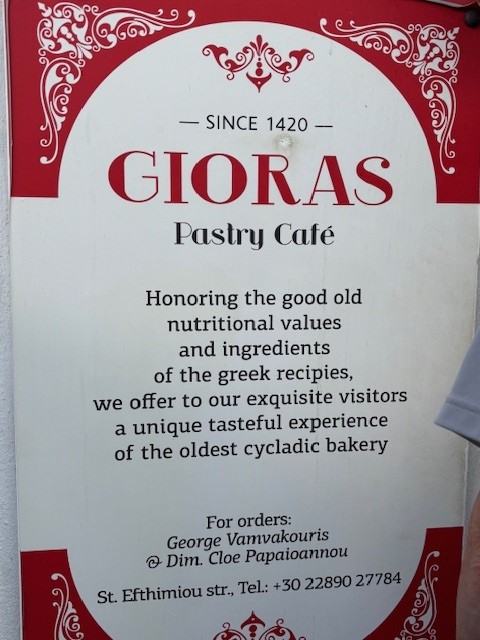
The inspiration for this week’s article caught my eye with its vibrant colour and sticky sweet layers. I’m standing in a bakery in Mykonos, Greece, that has a sign on the door: operating since 1420. So anyplace that’s been doing the same thing for 600 years, deserves all the accolades it gets.
Tucked away among the white-washed alleys of Mykonos Town lies one of the island’s sweetest living pieces of history: the bakery known locally as Gioras. Though claims of its founding in 1420 seem elusive in official records, the bakery is universally recognised as the oldest working bakery on the island and one of the last wood-fired bakeries in the Cyclades.
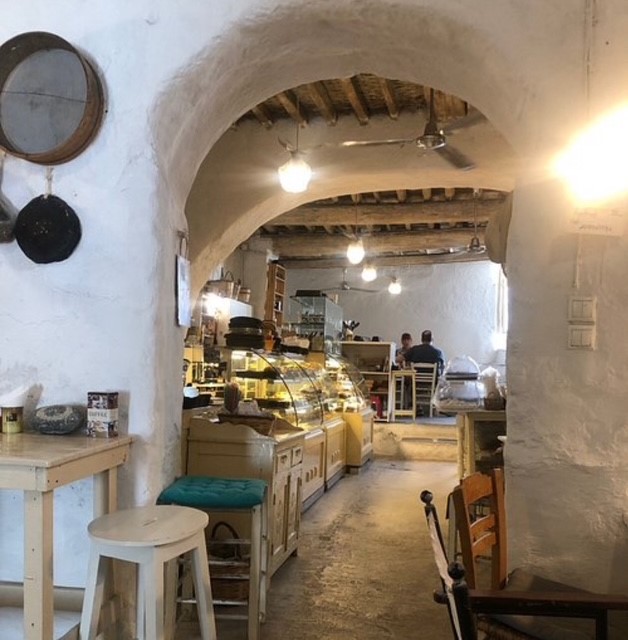
Inside, the scent of warm dough, tender rusks and syrupy sweet pastries permeates the small rustic space: nestled between other buildings, the white walls, exposed beams and original oven transport you to centuries-past.
Among the offerings that draw in both locals and visitors is a luscious slice of pistachio baklava served warm — crisp phyllo layers, fragrant pistachios and sticky honey syrup. What makes this particular version special is the combination of artisanship (wood-fired baking, centuries-old technique) with a premium nut (pistachio) and honey-rich syrup — all anchored in Greek culinary heritage.
While the exact founding date like 1420 may be romantic and perhaps partially legendary, the essence of the bakery’s significance is clear: it represents survival of craft — from cultivating local flour and wood-fired ovens, to the traditional breads and pastries once essential for island life. For example, the bakery still produces the rusks that sustained sailors on long sea voyages.
So when one sits with a slice of pistachio baklava here, it’s more than a dessert: it’s a bite of local history, flavour and culinary continuity.
Honey is deeply embedded in Greek gastronomy, tradition and symbolism. It is one of the three “classics” of Greek cuisine alongside olive oil and grapes. Honey appears in ancient Greek texts, used not merely as sweetener but as a symbol of fertility, well-being and hospitality.
So at Gioras, the use of honey in the baklava isn’t an incidental choice — it connects to a centuries-old tradition of sweetening with nature’s own nectar, and embedding desserts in cultural memory.
Pistachios in Greece, while perhaps less universally used than walnuts or almonds in older Greek desserts, have their own vibrant role — especially when it comes to premium or regional sweets. Some important facts. The pistachio from the island of Aegina (fistíki Aigínis) has Protected Designation of Origin (PDO) status, underlining its uniqueness and cultural importance in Greece. While many “classic” Greek baklava versions use walnuts, pistachio versions often appear in higher-end shops or as special treats.
In the context of Gioras’ pistachio baklava, the nut elevates the dessert: it adds colour (emerald green-tinged), texture (distinctive crunch) and premium flavour — aligning with the bakery’s heritage of craftsmanship.
If you find yourself wandering the winding alleys of Mykonos Town, stop at Gioras — ask for a warm slice of pistachio baklava and pair it with a Greek coffee. Let the aroma of wood-fired oven, the history of the place and the sweetness of honey and pistachio transport you.
I only have pictures and memories this time. When I return home, the first order of business will be to attempt to recreate this magical dessert.