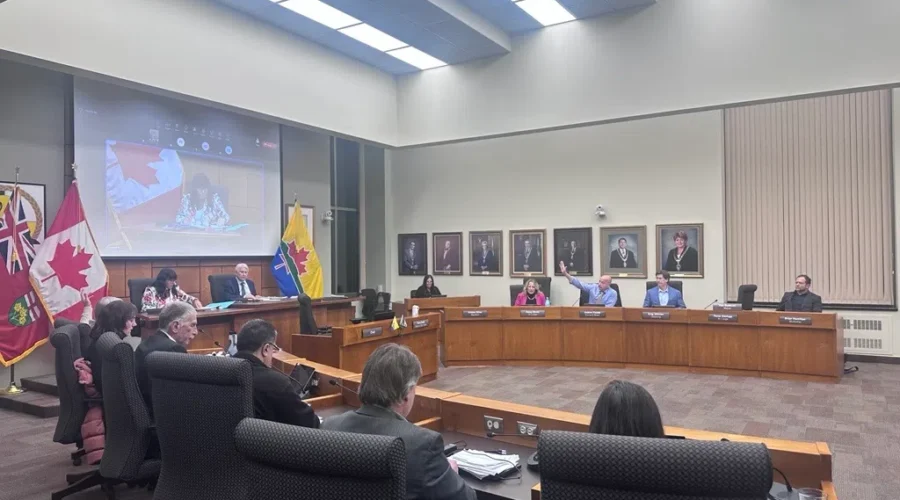
City council was given two locations to pick between for a temporary shelter village, but they opted for neither.
The city’s goal of establishing a location by the end of April 2025 will not happen.
Administration brought two options to Monday night’s Committee of the Whole: 114 Miles Street East and Kam River Heritage Park.
They suggested that council adopt the Miles St location, but council voted against it.
This location was suggested due to the lower associated costs, and higher public approval.
The estimated cost is $4-$4.3 million, and 68 per cent of public consultation respondents preferred this location.
This location would accommodate 80 shelter units which was considered easier to manage than the proposed 100-unit Kam River location.
Other benefits highlighted by administration are that this location would not require an encampment to be moved and that it is closer to public transportation and supportive services.
“These enactments are a visible sign of systemic gaps and we cannot afford to look away or continue with business as usual,” added the Encampment Response Plan Lead, Rilee Willianen. “The temporary village offers us an opportunity to do better and continue being better in this space.”
Administration believes the village will help downtown revitalization efforts and offer a significantly better alternative to unmonitored and unsupported encampments.
The Kam River Heritage Park option would have accommodated more units, but it presented other challenges the city had to consider.
The cost of the location was higher coming in at an estimated $5.9-$6.8 million.
According to city administration, the higher costs are due to site preparation requirements, and required service upgrades.
Other concerns included higher potential operating costs because of its layout and higher maximum capacity.
“From the thorough evaluation and analysis process, only two sites, 114 Miles St east and Kam River Heritage Park, reasonably satisfied all evaluation criteria, while balancing cost and feasibility,” explained Willianen.
Administration noted public consultation had a significant impact on their decision-making, but the validity of the survey used was heavily discussed.
The survey only had 698 responses.
Of those responses, 67 per cent of respondents do not live or work in the downtown Fort William area, and 68 per cent voted in favour of Miles Street.
Priorities highlighted by respondents include security and onsite staff (489 responses), and garbage cleanup in surrounding areas (361 responses).
For the councillors a point of debate was the approved human rights approach, with everyone acknowledging the need to support both business owners and the homeless population.
“We need to help the most vunerable, the people who are unhoused need homes,” explained At-Large Councillor, Rajni Agarwal. “The other side of the human rights are the business owners in the immediate area.”
“How can we publicly enforce the devaluation of people’s property? We have to be careful what we do and how we choose it.”
Ultimately a consensus could not be reached on how exactly they should move forward.
“So even though tonight is really about location the reality is if we say no we are saying yes to the status quo, and I think we can all agree it is not working, we have tents in every neighborhood in this city, that is not hopeful that is not stable,” said Current River Councillor, Andrew Foulds. “Frankly, we are not doing well, the status quo is not hopeful. It is shameful that this issue has been dumped on municipalities across the country. Both of the other orders of government should be embarrassed.”
Moving forward it’s unclear when administration will return with new information and suggested sites.
“It is important to acknowledge that delaying action over disagreement over which site leaves us in the same situation we’ve been in for years,” highlighted the Director of Strategy & Engagement, Cynthia Olsen. “The temporary village is a response to the immediate process, a transitional and temporary solution for the next three to five years that will provide stability, dignity, and support for individuals while we work toward the ultimate goal of long-term sustainable housing for all and revitalizing our downtown south core.”
Temporary villages are managed environments, that are completely different from unregulated encampments, which can pose public health and safety risks.
“(They) offer immediate relief to the encampment crisis by stabilizing residents and bridging the gap until permanent solutions such as social, supportive and transitional housing become available,” added Willianen. “They are integral parts of the existing systems working alongside community partners to ensure seamless integration and alignment with long-term housing strategies. ”
The village, whenever complete will offer residents a reliable source of food, access to social services, and shower facilities.
Local service organizations like Shelter House, Elizabeth Fry Society, John Howard Society, and Indigenous Friendship Centre sent letters in support of the suggested Miles St location prior to Monday night’s meeting.
Council declined to select from the two options at Committee at the Whole and instead opted to refer back to administration, but it is still barring approval at City Council.
If approved at City Council, the villages will be sent back to administration to look at alternative locations.