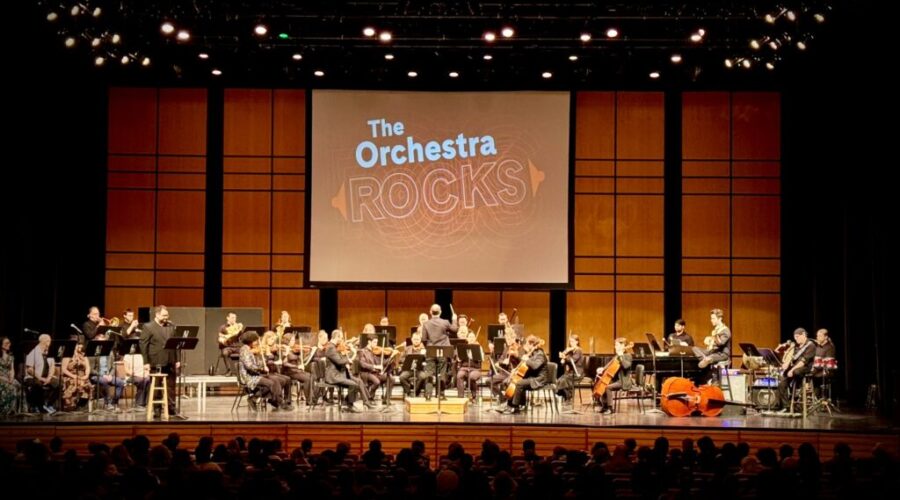
The first notes are tentative – hundreds of young hands adjusting their recorders. Then, with a lift of the baton, the sound settles into a unified whole. What begins as a classroom exercise becomes something much larger, as elementary students from across Thunder Bay this week find themselves performing alongside the symphony.
Inside the Thunder Bay Community Auditorium, the culmination of months of preparation is unfolding through the orchestra’s Link Up program, an international music education initiative developed by Carnegie Hall. Now adopted by orchestras across North America, the program connects classroom learning directly to the experience of live performance.
And this week, that experience is alive in every corner of the auditorium.
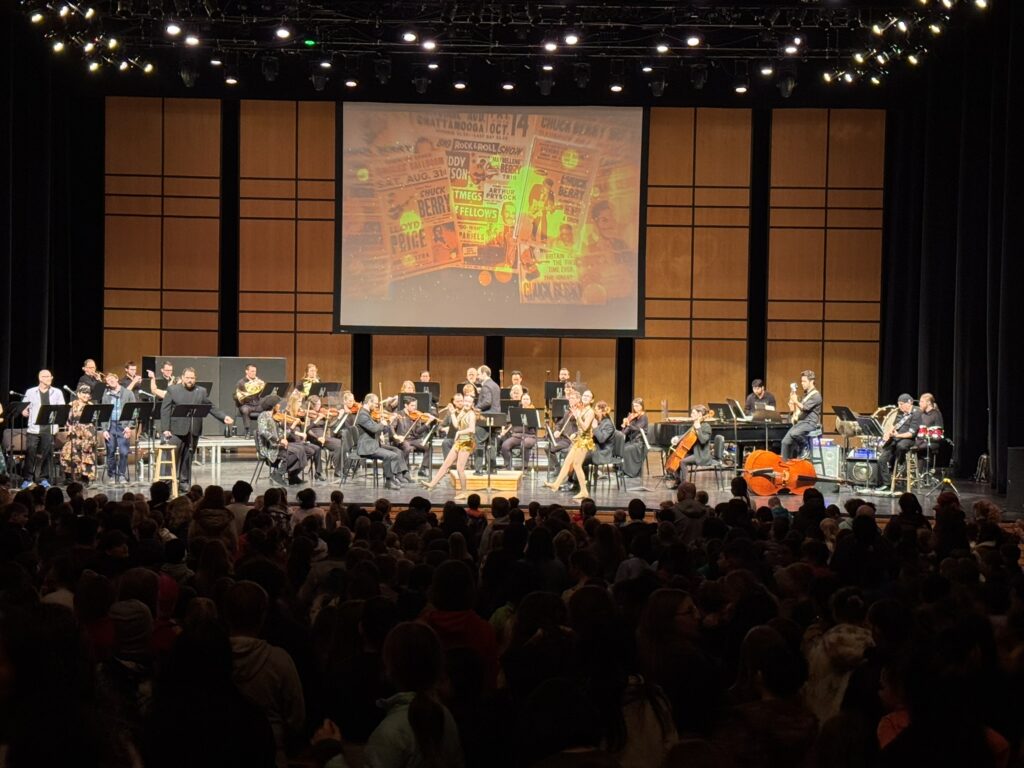
The main floor is a hive of activity, with students holding recorders. However, their involvement goes beyond simple note-playing. They are singing, clapping to the rhythm, and tracking the sheet music projected on the screens. A powerful moment occurs when the steady pulse of a drumline, provided by local Sea Cadets, breaks through the space. This beat gives the students a common rhythm to lock into, their hands uniting as the rhythm transforms into a physical, shared, and deeply felt experience.
As the orchestra launches into Johnny B. Goode, the energy lifts instantly. Students begin moving in their seats, hands jiving to the beat, shoulders bouncing, dancing in the narrow spaces between rows. It’s spontaneous and joyful, a reminder that music isn’t just something to be played, it’s something that moves you.
In some classrooms, that connection to the music starts long before students arrive at the auditorium, said Rob Hole, a teacher with the Thunder Bay Catholic District School Board.
“We did Link Up on ukuleles back at the school, playing Johnny B. Goode and singing it,” he said. “You’re not just playing the melody, you’re playing the chords and singing at the same time.”
There are dancers too, bringing movement to the music and reinforcing what students have been learning in their classrooms for weeks: that music is not just something you hear, but something you experience.
In classrooms, that work begins months in advance.
“I often introduce Link Up at the end of October or the beginning of November,” Hole said. “We take some time off for Christmas songs, and then we come back to it again in January.”
Those months of preparation are about more than learning notes.
“Music gives the school a soul,” Hole said. “It gives joy and excitement—something different. It’s a mix of everything. It’s history, it’s math, science. It encompasses everything.”
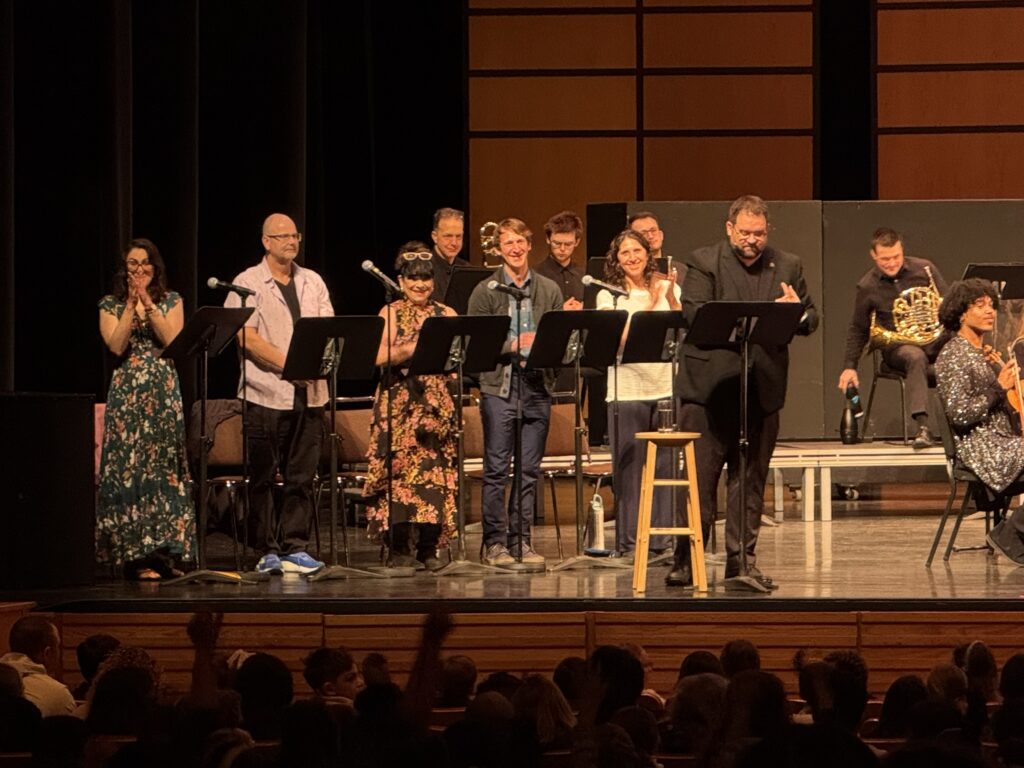
Students are introduced to music in a variety of ways, through instruments in their hands, rhythm they can feel, and voices they can use.
“I love the growth you see in the students from one week to the next,” Hole said. “A month ago, we were just struggling. Now, you can hear the songs – you can see the smiles on the kids’ faces because they’ve achieved something.”
That sense of progress leads directly to moments like this.
“They get together with other students, they see friends they play hockey or soccer with, and they talk about the same songs,” he said. “Now they’re all together doing it with a live orchestra, in this beautiful building – it’s just amazing.”
That shared experience is exactly what the program is designed to create.
“There’s so much value,” said Frédéric-Alexandre Michaud, resident conductor with the Thunder Bay Symphony Orchestra. “On a personal level, it’s one of the best ways for self-confidence, where students and kids can learn to work on something that takes a long time.”
That process, he said, stands in contrast to the immediacy of much of modern life.
“It develops the brain, the self, the idea of taking the time to learn something that is not instant gratification—it takes a long time.”
And it doesn’t happen in isolation.
“You’re part of a group, a big group of people, and you have the chance to play with a symphony,” Michaud said. “So there are so many different types of value, learning an instrument, how to sing, how to dance, but also being part of a community.”
For many students, this marks a first: their first instrument, their first large-scale performance, their first time hearing the full force of a live orchestra firsthand. The distance between audience and performer disappears, replaced by something immediate and collaborative.
The benefits of music education in schools are well established, but programs like Link Up bring those outcomes into focus, supporting memory, attention, and creativity, while building confidence, discipline, and teamwork.
It also reflects the broader role the orchestra plays in the region.
“One of the benefits of the orchestra being here in Thunder Bay—and across the region—is the educational component,” Michaud said. “A lot of what we do is educational concerts for schools.”
Sometimes that means introducing students to live music. Other times, like today, it means inviting them to take part.
“Students prepare songs at school to come sing with the symphony,” he said. “We really try to make sure that we support music education in the region.”
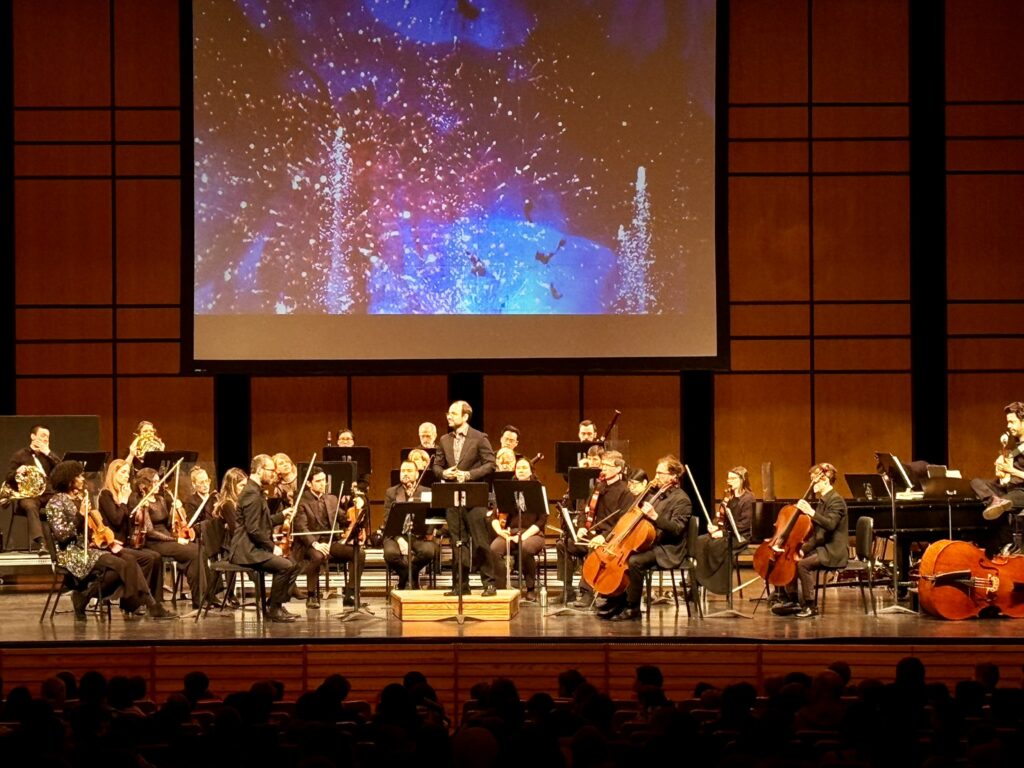
That impact extends well beyond the concert hall.
“Besides the orchestra itself, the musicians are part of the community; they teach students, they play in smaller groups around town,” Michaud said. “So having the orchestra is good, not only for what happens today, but for all the other things that are connected to it.”
Moments like this are also made possible through strong community support.
“All the support that is given by the school boards, the donations from donors, allow us to be able to do this and to connect with kids,” he added. “It’s really important to recognize that support for events like today.”
In a community like Thunder Bay, where a professional orchestra and dedicated teachers from all school boards work hand in hand, students are given the chance not just to learn music but to experience it truly.
As the final piece comes to a close, the energy in the room shifts once more. Applause fills the auditorium from the students themselves, who, just moments earlier, were fully immersed in the music.
Recorders lower. Smiles spread. Some students glance at one another, as if to confirm what just happened. A sense of accomplishment is visible.
For a brief time, they weren’t just learning music.
They were making it—together.