


The soft whirr of an eight-track spun through our living room, the scent of worn vinyl lingering in the air as music drifted out from beside the old brown sofa. Before streaming playlists and pixelated album covers, The Irish Rovers entered homes like mine wrapped in the tactile crackle of tapes and records. For many Canadians, their first encounter with the band wasn’t mediated by an algorithm. It was a moment in a living room, the machine humming low and familiar, songs unfolding from physical grooves and magnetic strips.
George Millar laughs at the memory.
“I still have some fans asking if we have any eight-tracks for sale,” he says. “And I say no, sorry. I’ve got a couple, but it’s The Eagles and The Beatles. That’s what I have left.”
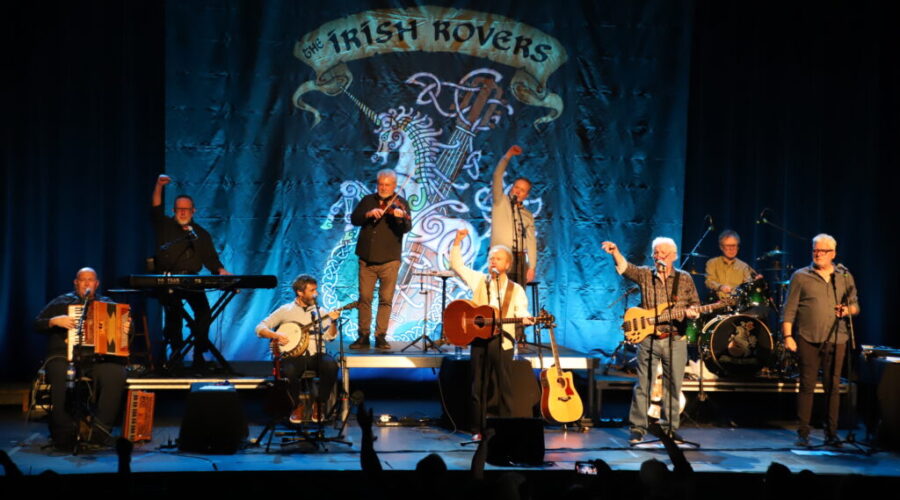
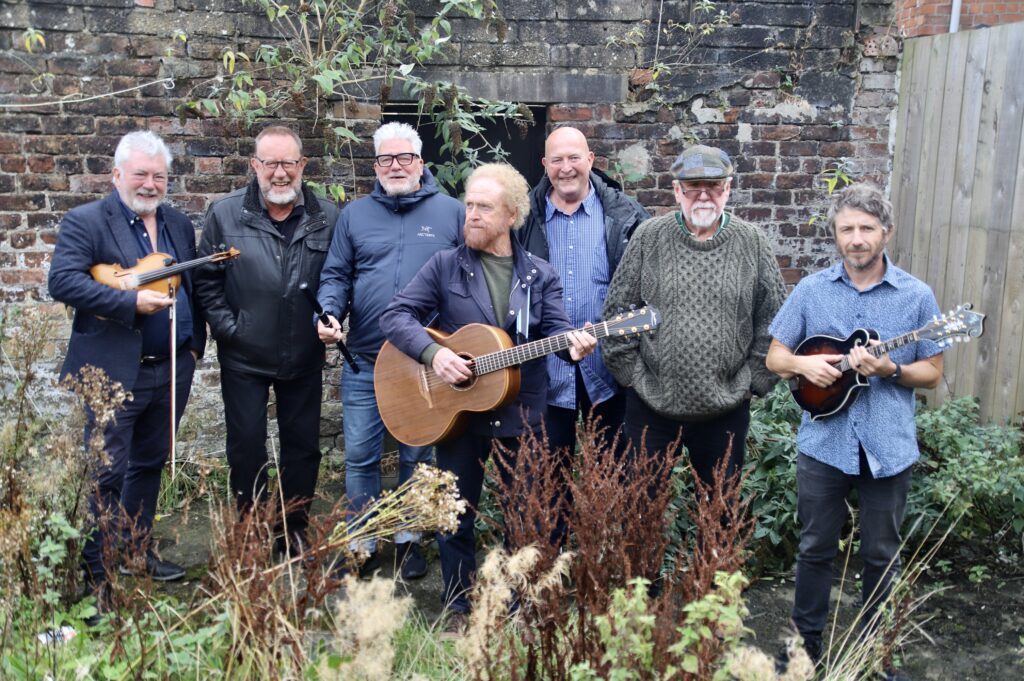
More than six decades after founding the band in Toronto in 1963, Millar remains both amused and slightly astonished by how long the road has stretched. What began as weekend gigs in Toronto folk clubs, earning $25 a night, has grown into a career that now includes a St. Patrick’s season tour, a new album titled The Belfast Sessions, and even a new whiskey.
But it was never meant to last this long.
“Absolutely not,” Millar says when asked if he imagined this future. “We were doing it strictly as a lark. I was finishing school. Jimmy was working at Eaton’s. We thought, let’s give it a year and see how it goes. It’s great fun.”
That one year became 60.
“I suppose after all this time, we’re still saying, ‘Ah, we’ll give it another year and see how it goes.’ I think we’re on our third farewell tour,” he adds. “Cher’s on her seventh, so we’ve a few yet to go.”
In those early days, success felt improbable. Millar remembers thinking he was rich at 16, pocketing his $25 share and letting the older bandmate buy the beer for rehearsals. His mother, however, remained unconvinced.
“She used to say, ‘When are you going to get a real job?’” Millar recalls. “I said, well, this sort of is my job. She says, ‘What? You’re only singing. That’s not a job.’”
He still jokes about it. Then he turns serious.
“It’s a full-grown thing,” he says of the work. “The hours of rehearsing. The hours sitting trying to write a new song. Learning new material. People don’t always see that part.”
He appreciates when conversations move beyond nostalgia and into the craft itself — the repetition, the discipline, the unseen labour that keeps a band sharp after 60 years.
“Well, of course it’s a job,” he says. “You have to practise and practise and rehearse and rehearse. That’s how it’s done.”
Millar still writes the way he always has — with a pencil and a yellow pad. When a melody strikes, he reaches for a small cassette recorder and hums it into tape.
“I guess I’m a dinosaur,” he says lightly.
That devotion to process shaped The Belfast Sessions, recorded at RedBox Studios in a Victorian house in Belfast. After years of piecing together tracks remotely — sending files from British Columbia to Ireland, Florida and Montreal — Millar longed to be back in the same room.
“I always preferred to be together in the studio. Eye contact is very important,” he says. “When you’re looking at each other, you just know — OK, let’s pick this up a wee bit. Let’s hit the chorus harder.”
The band recorded across three floors of the house — drums on one level, musicians in a circle on another, Millar upstairs, laying down what he calls a “scratch vocal” to guide tempo and feeling.
“It’s magic,” he says. “You can’t do that piecemeal.”
Returning to Belfast carried a deeper meaning. Millar emigrated from Northern Ireland as a teenager. Recording there felt like a circle closing.
“It was absolutely like a homecoming,” he says. “Almost like full circle.”
There were rumours, he adds with a laugh, that the local Guinness supply ran dangerously low during the two-week session. “Mind you,” he says, “we all added about 10 pounds.”
Millar once described The Irish Rovers as a “Band Without A Country.” In Ireland, he was told the band wasn’t “Irish enough.” In Canada, he was told they weren’t “Canadian enough.”
In the 1960s and 70s, national authenticity carried weight in folk music circles on both sides of the Atlantic. Purists in Ireland guarded traditional forms, while artists in Canada navigated their own evolving cultural identity. The Rovers’ sound — blending pub nostalgia, maritime storytelling and North American warmth — did not sit neatly in either camp.
“I thought, for God’s sake,” Millar says. “We’re not Irish enough in Ireland, and we’re not Canadian enough here.”
He wrote the song tongue-in-cheek, not out of bitterness. Today, he carries that dual identity with pride.
“I feel sorry for bands that fall somewhere in between,” he says. “They’re not rock enough, not country enough. So what are they? But they have fans. And that’s what matters.”
Canada has long been central to that story. It was here that the band broke through with The Unicorn in 1967. It was here they became a Sunday-night staple alongside The Beachcombers and Disney programming. It was here they influenced a new generation.
Millar recalls standing side-stage at a Milwaukee fair watching Great Big Sea open a show when Alan Doyle turned to him and said, “Without you guys, we wouldn’t be here.”
“Well,” Millar laughs, “you only had one channel. You had to watch us.”
Still, the compliment stayed with him. When Great Big Sea later disbanded, he felt the loss.

“I thought they were the type of band that could take over from our generation,” he says. “A real band that could have a weekly TV show again. It was a shame.”
Songs like “Drunken Sailor” continue to find new life. Young fans approach him after shows, insisting it must be a recent composition.
“They say, ‘When did you write that?’” Millar says. “I tell them it’s three or four hundred years old. And they say, ‘No, no, seriously.’”
As an older man now, he receives letters from people who say the music helped them through difficult times. He keeps them all. On days when he feels low, he reads through them.
For him, that is the reward — a reminder that music can be, in his words, a tonic for the soul.
Humour remains just as essential.
“It’s probably what got the Irish through 800 years of troubles,” he says. “Music and humour go hand in hand.”
In kitchen parties across Ireland — and, he notes, in Newfoundland — someone always had to contribute. If you couldn’t sing or dance, you told a story. You told a joke. There was always laughter.
In what he calls a “mad, mad world,” that laughter still matters.
“If you don’t enjoy it, you shouldn’t be doing it,” he says. He can tell when bands have lost that spark — when they don’t make eye contact, when they’re there only for the money.
For Millar, the connection remains real. The shared glance in the studio. The exchange on stage. The autograph signed without hesitation.
“If somebody wants an autograph, we do it,” he says. “We don’t say, ‘Sorry, we’re stars.’ That’s not in our makeup.”
Asked what he would tell his younger self in 1963, Millar pauses.
“I would say, be more positive. Don’t think it’s only going to last a year. And start writing songs earlier.”
He did not begin writing seriously until his 30s, relying first on the traditional tunes he learned as a child. He also jokes that he might have taken better care of himself.
“As Keith Richards said, if I’d known I was going to live past 40, I would have taken a hell of a lot better care of myself.”
Gone are the days of living on cheeseburgers — he was once known as “the cheeseburger kid.” These days, he follows a largely plant-based diet and has even written a song called The Vegan Christmas Feast as a gift to his wife.
There is a joke Millar loves about a young musician in New York who asks a taxi driver how to get to Carnegie Hall.
“Practice, my son, practice,” the driver replies.
It is, he says, the only real answer.
There are no overnight sensations. Even the artists who rise quickly have spent years learning their craft somewhere out of sight.
For Millar, that craft began in classrooms in Northern Ireland, carried across the Atlantic to Toronto folk clubs, and has now circled back to Belfast studios and stages across North America.
The Irish Rovers bring their St. Patrick’s season tour to the Thunder Bay Community Auditorium on March 10 at 7:30 p.m. The evening will feature favourites spanning six decades, along with selections from The Belfast Sessions, and, as always, the stories and humour that have defined the band’s run.
Sixty years on, Millar is still giving it another year to see how it goes.
Touch wood.


