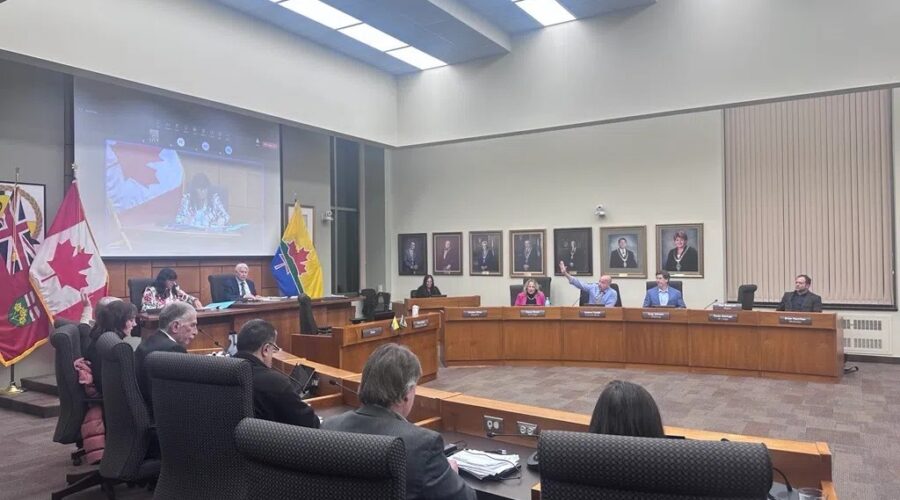
Thunder Bay’s city council has tentatively selected a site for the city’s Temporary Shelter Village Initiative.
City administration’s original and most recently suggested site, 114 Miles Street East has been approved by council at Monday night’s committee of the whole.
The vote was six to five.
Red River Ward Councillor Michael Zussino and Mayor Ken Boshcoff were not present to participate in the vote.
Councillors Shelby Ch’ng, Kristen Oliver, Brian Hamilton, Greg Johnsen, Kasey Etreni, and Andrew Foulds voted in favour.
Councillors Dominic Pasqualino, Trevor Giertuga, Rajni Agarwal, Albert Aiello, and Mark Bentz voted against.
The decision came at committee of the whole and still needs to be confirmed and ratified at the July 21 city council meeting.
If city council opts to reverse course and decline the Miles Street location, then $2.8 million in grant funding would be in jeopardy.
To meet the deadlines to receive the grant, at least 40 units must be ready to start accepting occupants by December 15, 2025, and the remaining units must be fully operational by February 27, 2026.
Because of this, the city plans to have construction underway in August if approved at city council.
If finalized city administration will continue working through the process of selecting contractors for the project.
“Nobody, not a single municipality in Canada has solved the challenges associated with homelessness,” said City Manager John Collin. “If anybody had, we would all be embracing that approach.”
“What we do know is that the challenges associated with homelessness are getting worse. Put another way, the status quo is not working. There are more people experiencing homelessness, and the impact on the broader community is more pronounced every year.”
The Vice-Chair of the Fort William BIA, Tony Dipaolo, provided a deputation at Monday night’s meeting, expressing the organization’s opposition to the initiative.
Meanwhile, the Thunder Bay Police Service, Shelter House, Dew Drop Inn, St. Joseph’s Care Group, and NorWest Community Health Centres, were among several organizations that sent city council letters of support for the project ahead of Monday night’s decision.
“Addressing the root causes is not our direct role, and even trying to take it on would be impossible since we lack the expertise and the resources to do so,” said Collin. “But municipalities under legislation and I would also offer morally have an obligation for community safety and wellbeing.”
If the project is finalized, the city also plans to continue working through its Enhanced Encampment Response Action Plan.
The plan includes goals like public engagement and education opportunities through in-person meetings, videos, infographics, podcast appearances, event attendance, social media updates and more.
The village will be temporary, and it is seen as an interim solution that bridges the gap for the unhoused while permanent supportive housing and other homelessness supports are developed.
The hope is that the project will help people living in encampments by providing access to essential services like housing and social supports off-site.
The city also highlights that it will help downtown revitalization by reducing the population in unmanaged encampments.
According to city administration, the Miles Street site was proposed for a variety of reasons.
“I can assure this council and the general public that the work was intense, and contrary to what has been suggested in some social media posts, administration was not that dogmatic or pigheaded and not stuck on the Miles Street location,” explained Collin. “But in the end, based on our professional judgement and extensive analysis, Miles Street is by far the recommended site by administration, in that it offers the best chance of success.”
“In terms of first of all helping those experiencing homelessness, secondly contributing to the safety and well-being of the rest of the city, and thirdly, promoting an image and an environment for our city that will spur growth and help the city thrive.”
The Miles Street site is a strong financial option cost-wise, with the ability to accommodate 80 units, while also being close to service providers.
The Thunder Bay Police Service has also identified the location as the one that poses the least amount of risk.
The city has a few initiatives aimed at easing concerns raised throughout the site selection process.
The plan is to establish a Neighbourhood Liaison Committee to support communication and improvement.
An additional $125,000 will be given to the Fort William BIA for the duration of the project to support security enhancements.
An additional $50,000 is also being allocated in the city budget to support the cleanliness of the south core.
The 142 Simpson Street and immediately adjacent properties are also being removed from the future identification process for recognized encampment locations.
The city also hopes to have more Eye on the Street Program cameras installed where possible.
It was noted during Monday’s meeting that city council can opt to move the village once it is fully established.